- Home
- Products +
- Industries +
- About Us +
- News
- Contact Us

- Home
- Products
- Industries
- About Us
- News
- Contact Us

Aug. 18, 2026
Quick Answers
| Question | Short Answer |
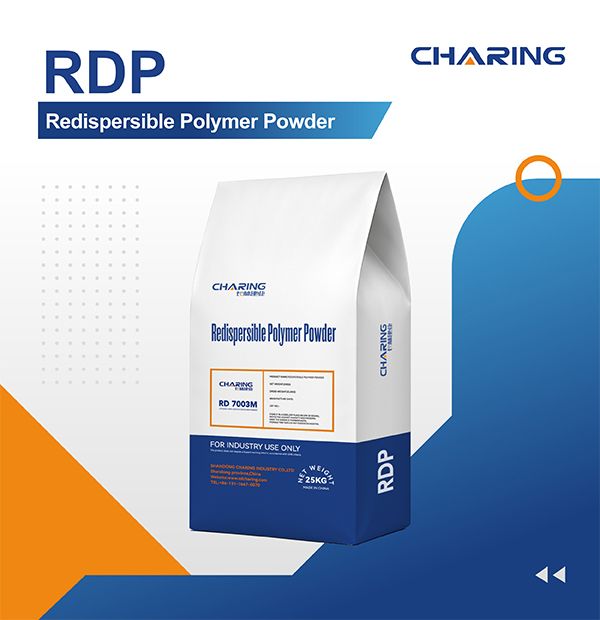
| What is the most common RDP chemistry? | VAE (vinyl acetate-ethylene). It is 80%+ of the market — best cost-to-performance ratio |
| When should I use VeoVa RDP instead of VAE? | Exterior walls in wet, alkaline, or humid climates. VeoVa adds hydrophobicity and alkali resistance |
| When is acrylic RDP worth the premium? | High-end exterior decorative renders, color-stable façades, UV exposure. Best weather resistance, highest cost |
| What about SBR? | High flexibility and mechanical strength, but poor UV — interior or non-UV applications only |
| What is the protective colloid and why does it matter? | Usually PVOH. It controls re-dispersibility, ash content, and water sensitivity of the RDP |
| Does CHARING make all four chemistries? | No. CHARING focuses on VAE plus a VAE-acrylic terpolymer for waterproofing — no VeoVa or pure acrylic grades |
1. The Polymer Backbone Defines Everything
Every RDP starts as a polymer emulsion, spray-dried into powder. The emulsion's monomer composition — its "chemistry" — determines the powder's final performance. Four chemistries dominate the market:
| Chemistry | Monomers | Tg Range | Water Resistance | Alkali Resistance | UV / Weathering | Relative Cost |
| VAE | Vinyl acetate + ethylene | -10°C to +15°C | Moderate | Fair | Good (may yellow slightly) | Lowest |
| VA-VeoVa | Vinyl acetate + vinyl versatate (+ ethylene) | -5°C to +5°C | Good | Excellent | Very good | Medium |
| Acrylic / Styrene-acrylic | Acrylate esters (+ styrene) | -20°C to +5°C | Very good | Excellent | Outstanding (no yellowing) | Highest |
| SBR | Styrene + butadiene | -20°C to 0°C | Good | Good | Poor (UV degrades) | Medium |

E-mail: sdcharing@sdcharing.com
Phone: +86 131 7667 0070
WhatsApp: +8615066133527
Add.: No.605-606,NO1 BUILDING,WANGYUE ZHIGU INDUSTRY PARK,NO.1919 WANGYUE ROAD, SHIZHONG AREA,JINAN CITY, SHANDONG PROVINCE,CHINA