- Home
- Products +
- Industries +
- About Us +
- News
- Contact Us

- Home
- Products
- Industries
- About Us
- News
- Contact Us

CHARING manufactures HPMC, RDP, and PCE for dry-mix mortar and concrete — supplying high quality products across Southeast Asia, the Middle East, South America and Africa for over a decade. We share what we know.
Part 1 — Waterproofing
1. Four Systems, Four Standards
China defines waterproofing under four standards. Each standard is a different material with different properties.
| System | Standard | Form | Flexibility | Tile on top? |
| Polymer waterproof mortar | JC/T 984 | One-part dry powder | Rigid (≥18 MPa) | Yes, directly |
| Polymer waterproof slurry (K11) | JC/T 2090 | Two-part (powder + liquid) | Type I semi-rigid / Type II flexible | Type I yes, Type II needs C2 |
| JS waterproof coating | GB/T 23445 | Two-part (powder + liquid) | Flexible to highly flexible | Needs screed |
| CCCW (capillary crystalline) | GB 18445 | One-part dry powder | Rigid, penetrates concrete | Yes, on concrete |
All systems must also meet GB 55030-2022, the mandatory national code for building waterproofing design life.
2. The Rigid-to-Flexible Spectrum
Rigid ←- - - - - - - - - - - - - - - - - - - - - - - - → Flexible
JC/T 984 K11-I K11-II JS-I JS-II JS-III
(mortar) (wall) (wall) (floor) (floor) (special)
↑ ↑ ↑
tile directly needs C2 needs screed + C2
The rule: rigid waterproofing bonds well to tiles but cracks under movement. Flexible waterproofing absorbs movement but is a poor base for tiles. Pick by whether you tile on top (wall) or not (floor).
3. Polymer Waterproof Mortar (JC/T 984)
The standard waterproofing for tiled walls — bathrooms, kitchens, balconies.
One-part dry powder. Mix with water, apply 5–8 mm thick. The most rigid system — high strength, near-zero elongation. Tile adhesive bonds to it almost as well as to bare concrete. No screed needed.
Reference Formula
| Material | Amount (kg/t) | CHARING Product |
| Cement 42.5 | 300–400 | — |
| Sand 70–140 mesh | 500–600 | — |
| RDP | 15–30 | RD 8080F / RD W8050 |
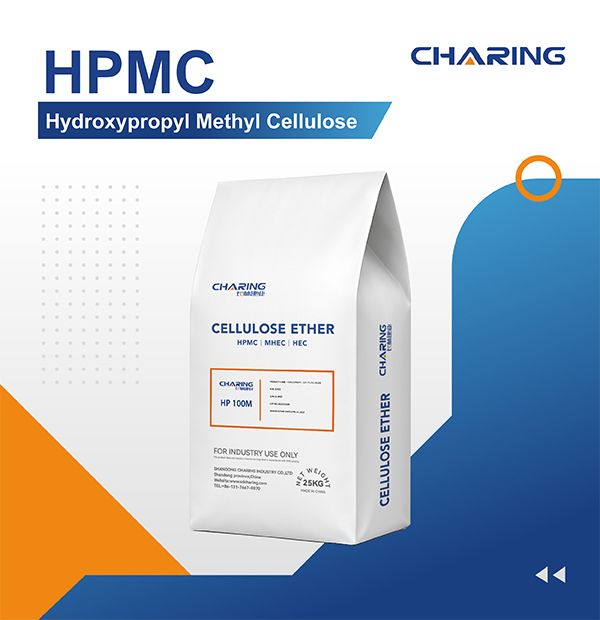
| HPMC | 2.0–3.0 | HP 60M |
| Hydrophobic agent | 2–5 | S500 |
| Defoamer | 0.5–1.5 | D802 |
| PP fiber (3 mm) | 1–2 | — |
Water: 16–18%.
4. K11 Polymer Waterproof Slurry (JC/T 2090)
Two-part: powder (cement + sand + additives) + liquid polymer emulsion, mixed on site. "K11" was originally a Davco trade name, now used generically for JC/T 2090 products.
Type I vs Type II
| Property | Type I | Type II |
| Flexibility | Semi-rigid | Flexible |
| Transverse deformation | ≥2.0 mm | — |
| Elongation | — | ≥30% |
| Best use | Wall | Floor |
| Tile on top | Directly | C2 adhesive, or screed |
K11 Type I ≈ JC/T 984 mortar for walls. The difference: K11 mixes polymer on site for slightly better crack-bridging. JC/T 984 is a dry powder — simpler logistics, no liquid to ship.
5. JS Waterproof Coating (GB/T 23445)
The most flexible cement-based waterproofing. Two-part: powder (cement + filler) + liquid polymer emulsion (styrene-acrylic or VAE). Applied 1.5–2.0 mm in 2–3 cross coats.
| Property | Type I | Type II | Type III |
| Tensile strength | ≥1.2 MPa | ≥1.8 MPa | ≥1.8 MPa |
| Elongation at break | ≥200% | ≥80% | ≥30% |
| Best use | Roofs | Bathroom floors, balconies | Walls |
Why tiles fail on JS: a flexible membrane stretches under tile weight. C1 adhesive cannot follow, it cracks, water enters, tiles fall. JS-I (200% elongation) is never directly tileable.
The fix: for JS-II or more flexible, put a 3–5 mm cement screed between the membrane and the tile adhesive. Or use C2S1 adhesive with RD 8080F at 30–40 kg/t.
6. CCCW — Capillary Crystalline (GB 18445)
Dry powder: Portland cement + quartz sand + active chemicals. Applied to concrete, the chemicals penetrate capillary pores and react with calcium hydroxide to form insoluble crystals that block water.
Use it for: basements (negative side), concrete water tanks, tunnels, underground structures.
Do not use it for: brick walls (needs concrete), flexible substrates, cracks >0.4 mm (needs epoxy first), bathroom walls (overkill — use JC/T 984 or K11).
Self-healing: a new crack up to 0.4 mm reactivates the dormant chemicals when water enters, growing new crystals that seal it. This is why CCCW is specified where repair access is impossible.
7. Choose by Location
| Location | System | Why |
| Bathroom wall (tiled) | JC/T 984 or K11-I | Rigid, bonds to tile |
| Bathroom floor | JS-II or K11-II | Needs flexibility, C2 adhesive |
| Kitchen wall | K11-I | Semi-rigid, economical |
| Balcony floor | JS-II | Thermal movement from sun |
| Roof / terrace | JS-I | Maximum flexibility |
| Basement wall | CCCW | Negative-side, self-healing |
| Concrete water tank | CCCW | Penetrating, potable-water safe |
| Swimming pool | JS-II | Flexible continuous membrane |
| Exterior wall (rendered) | JC/T 984 | Rigid base for render |
8. Tiling Over Waterproofing — the #1 Failure Point
| Waterproofing | Adhesive Grade | RDP | Note |
| JC/T 984 mortar | C1 or C2 | RD 7015H / RD 8080F | Bonds directly |
| K11 Type I | C1 or C2 | RD 7015H / RD 8080F | Bonds directly |
| K11 Type II | C2 minimum | RD 8080F (30–40 kg/t) | Membrane deforms |
| JS Type II | C2S1 minimum | RD 8080F (30–40 kg/t) | >80% elongation |
| JS Type I | C2S1 + screed | RD 8080F (30–40 kg/t) | 3–5 mm screed required |
| JS Type III | C1 or C2 | RD 7015H / RD 8080F | More rigid |
| CCCW | C1 or C2 | RD 7015H / RD 8080F | Bonds to concrete |
Part 2 — Repair Mortar
9. Five Types of Repair Mortar (JC/T 2381)
Repair mortar fixes damaged concrete — cracks, honeycomb, spalled cover, damaged beams, slabs, columns, and walls.
China defines it under JC/T 2381-2016, which splits repair mortar into five types by function:
| Type | Code | For | Key requirement |
| Waterproof repair | W | Water-tight / anti-seepage repair | Waterproof pressure ≥1.5 MPa |
| Corrosion-resistant | C | Sulfate / chemical attack repair | Corrosion resistance ≥0.85 |
| Abrasion-resistant | A | Roads, floors, wear surfaces | Abrasion ≤0.50 g |
| Fast-setting | Q | Emergency / rapid repair | Initial set ≤30 min, 6 h strength ≥15 MPa |
| Self-compacting | S | Dense rebar, complex sections | Flow ≥260 mm |
For load-bearing structural repair, there is a second standard — JG/T 336-2011 — which grades mortar by load class (A = strengthening, B = load-bearing repair, C = non-load-bearing repair), with compressive strength from ≥45 MPa (A) down to ≥15 MPa (C).
10. Waterproofing vs Repair — Two Different Animals
People confuse the two. They are different:
| Waterproofing mortar | Repair mortar | |
| Job | Keep water out | Carry load, fix damage |
| Thickness | Thin, 5–8 mm | Thick, can exceed 10 mm |
| Key property | Water absorption ≤6% | Compressive strength ≥15–45 MPa |
| Shrinkage | Normal | Must be near zero (≤0.10%) |
| Typical additive | RDP + hydrophobic agent | RDP + PCE + expanding agent |
Repair mortar must be strong AND low-shrinkage. A repair patch that shrinks pulls away from the old concrete and fails at the bond line.
11. CHARING Products for Repair Mortar
| Repair type | CHARING product combination |
| Waterproof repair (W) | RDP (VAE) + PCE + hydrophobic agent |
| Corrosion-resistant (C) | RDP + sulfate-resistant additive |
| Abrasion-resistant (A) | Hard aggregate + early-strength agent + RDP |
| Fast-setting (Q) | PC 6030E (early-strength PCE) + RDP + accelerator |
| Self-compacting (S) | PC 3010 (water reducer) + RDP + thickener |
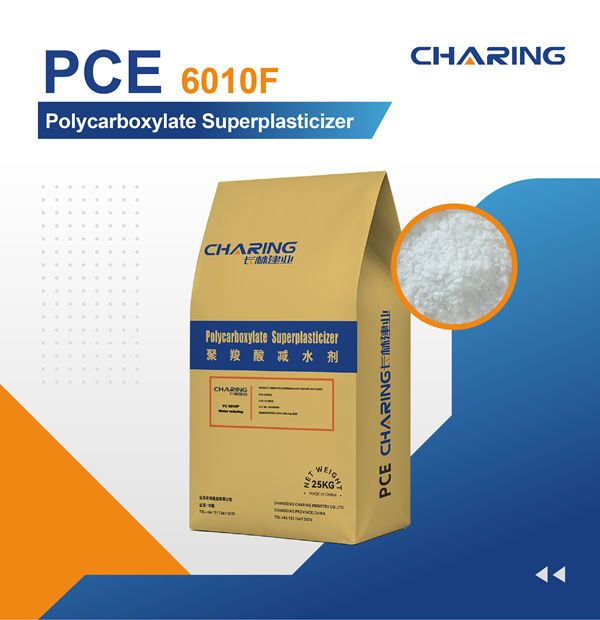
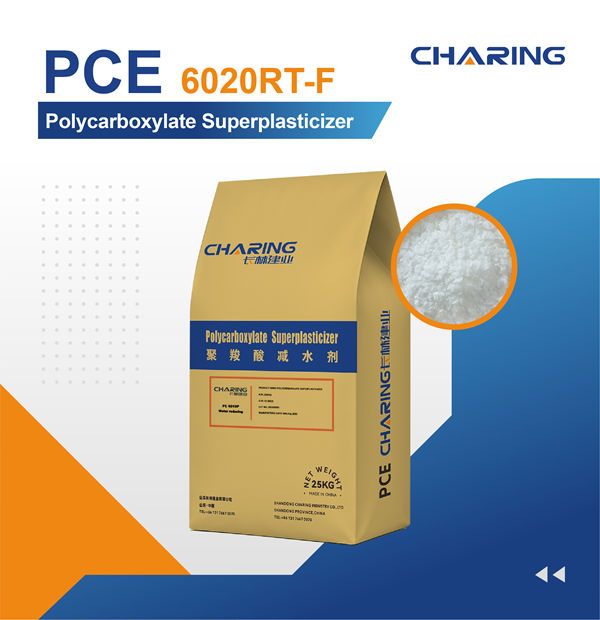
Two PCE grades matter here:
PC 3010 — high water reduction, for the self-compacting type (S). It gives flow without extra water.
PC 6030E — early-strength type (ASTM Type E), for the fast-setting type (Q). It shortens set time and builds strength fast.
12. Common Mistakes
1. Flexible JS on a tiled wall. The most common waterproofing failure. Wall waterproofing must be rigid — JC/T 984 or K11-I.
2. No hydrophobic agent in waterproofing mortar. Cement alone is not waterproof. Without RDP + hydrophobic agent, the mortar absorbs water.
3. Letting CCCW dry out. The crystalline reaction needs water. Dry it in the first 7 days and the waterproofing dies.
4. Ignoring shrinkage in repair mortar. A repair patch that shrinks pulls away and fails at the bond line. Use an expanding agent or sulfoaluminate cement to compensate.
5. Using waterproofing mortar where repair mortar is needed. Waterproofing mortar is not load-bearing. On a damaged beam or column, you need repair mortar — strength, not just water-tightness.
For technical support, free samples, or help with your waterproofing or repair formulation:
Shandong Charing Industry Co., Ltd.
Email: info@sdcharing.com
Website: www.sdcharing.com

E-mail: sdcharing@sdcharing.com
Phone: +86 131 7667 0070
WhatsApp: +8615066133527
Add.: No.605-606,NO1 BUILDING,WANGYUE ZHIGU INDUSTRY PARK,NO.1919 WANGYUE ROAD, SHIZHONG AREA,JINAN CITY, SHANDONG PROVINCE,CHINA