- Home
- Products +
- Industries +
- About Us +
- News
- Contact Us

- Home
- Products
- Industries
- About Us
- News
- Contact Us
Sep. 01, 2026
Your mortar works fine in spring. In August, it fails. You changed nothing. The surface skins over in minutes. The mortar turns crumbly. Why? It is not the dosage. It is the gel temperature of the cellulose ether.
Gel temperature is the temperature where HPMC or MHEC stops working. Below it, the cellulose ether holds water in your mortar. Above it, the cellulose ether turns to gel and stops holding water. Choose the right gel temperature, and your summer goes well. Choose the wrong one, and you get complaints from the site.
| Question | Short Answer |
| What is gel temperature? | The temperature where the cellulose ether gels and stops holding water |
| What is a normal HPMC gel temperature? | About 55–65°C for standard grades; higher with lower methoxy |
| What happens when mortar gets too hot? | The surface skins over, the mix turns crumbly, open time drops, it cracks |
| Which CHARING grade for hot weather? | HK (65–70°C) for fast-set jobs like tile adhesive and masonry mortar; MH (70–75°C) where long open time is needed |
| How much more cellulose ether in summer? | Add 0.1–0.2% more than your normal formula |
HPMC is a cellulose ether. It dissolves in cold water and makes a thick liquid. This thick liquid traps water in your mortar. That is what gives you open time and workability.
But HPMC has a special property. Heat it up, and it gels. The polymer chains lose their water. The methyl groups on the chain start to stick to each other, not to water. The thick liquid turns to gel. Then it stops holding water.
This is not a defect. It is normal HPMC chemistry. It is the main reason a mortar works at 20°C but fails on a hot wall at 60°C.
Two things matter:
Gel temperature is fixed by the grade. It is set by the chemistry, not by the dosage. More of the wrong grade does not help.
Hot walls are hotter than you think. A wall in direct sun can reach 50–70°C, even when the air is only 35°C. Cement hydration adds another 10°C inside the fresh mortar.
The gel temperature comes from the chemical groups on the cellulose chain. The rule is simple:
Methoxy (–OCH₃) hates water. More methoxy = lower gel temperature.
Hydroxypropyl and hydroxyethyl love water. More of them = higher gel temperature.
A normal HPMC has high methoxy (23–26%). It gels at about 55–60°C. Lower the methoxy, and the gel temperature goes up.
MHEC goes one step further. Its hydroxyethyl group loves water more than hydroxypropyl does. And MHEC usually has lower methoxy too. Both push the gel temperature up.
This is how the CHARING series is built:
| Series | Chemistry | Methoxy | Gel Temperature |
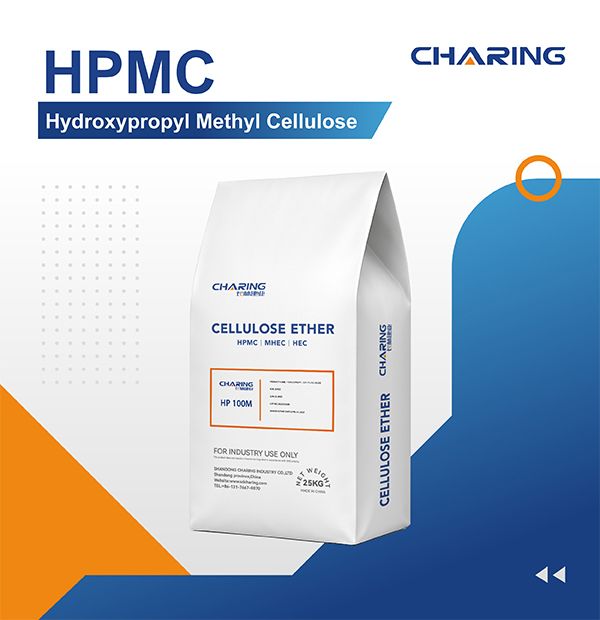
| HP | HPMC, high substitution | 23–26% | 55–60°C |
| HK | HPMC, medium substitution | 19–22% | 65–70°C |
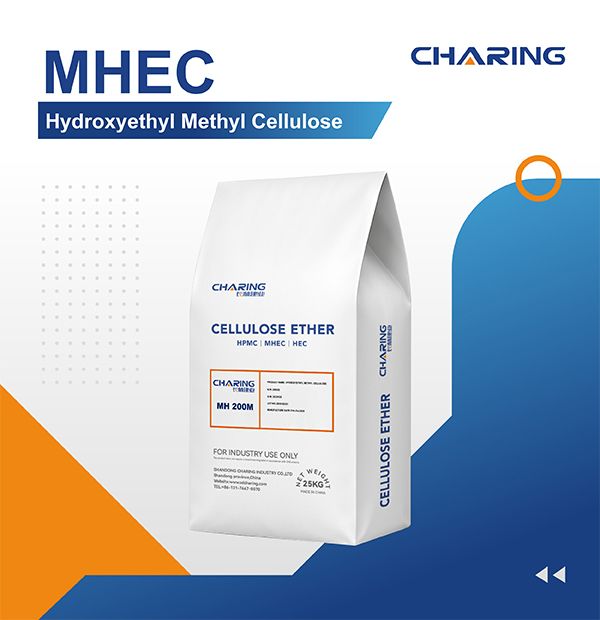
| MH | MHEC | — | 70–75°C |
This is not luck. HK has lower methoxy than HP. That is why HK gels 10°C higher. MH goes even higher — its hydroxyethyl group loves water more, and its methoxy is usually lower. So MH reaches 70–75°C.
Heat attacks your mortar from three sides.
Attack 1 — hydrogen bonds break. HPMC holds water through hydrogen bonds. Heat breaks these bonds. The network loosens. A 2% HPMC solution reads 10,000 mPa·s at 25°C. At 80°C, it can drop below 3,000 mPa·s. Ordinary cellulose ethers lose 40–50% of their viscosity in heat — even before they reach the gel point.
Attack 2 — heat gelling. When the wall reaches the gel temperature, the polymer gels and stops working. This is the sharp failure. Water retention does not just drop. It collapses. One industry study shows standard HPMC keeps only about 82% of its water at 50°C.
Attack 3 — water evaporates faster. Hot, dry air pulls water out of the fresh mortar faster than cement can use it. The cellulose ether is already weak. It cannot hold the water back.
On site, you see these problems:
The surface skins over in minutes, leaving a sandy, crumbly layer
Open time collapses — the trowel drags, tiles do not stick
Cracking and dusting, because the cement never finished hydrating
Hard lumps in the mix from uneven gelling
CHARING does not sell one grade with a "summer note". We sell three gel-temperature grades. But higher gel temperature is not always better. It has a cost. That cost decides which grade fits which job.
HP series — 55–60°C. The standard grade, and usually the right answer. High methoxy (23–26%) gives good solubility and a long open time of 30–40 minutes. Use HP for interior putty, skim coat, and normal plastering. Remember: interior work rarely reaches 50°C. So most of the time, HP is correct. You do not need a hotter grade.
HK series — 65–70°C. Good for heat, but with a real trade-off. Lower methoxy (19–22%) pushes the gel temperature 10°C higher. The mortar survives hotter walls. But lower methoxy also shortens the open time — about 20 minutes. After that, water retention drops fast. So HK is right for tile adhesive and masonry mortar. The tile or brick is set quickly. 20 minutes is enough. But HK is wrong for putty, skim coat, or coating. Those need water for a long time, so the cement can finish hydrating. Cut that short, and you get cracking and hollowing. The TDS for HK 100M and HK 200M states the gel temperature: 65–70°C.
MH series — 70–75°C. MHEC for real heat, without losing open time. MHEC reaches 70–75°C because its hydroxyethyl group loves water more, and its methoxy is usually lower. It holds water well even in heat. So it gives you heat resistance without cutting the open time short. Use MH for sun-facing facades, tropical and desert areas, and any wall that can hit 65°C or more.
The simple rule: match the grade to two things — the wall temperature and the open time you need. If it is not very hot, use HP. If it is hot and the job sets fast (tile adhesive, masonry mortar), use HK. If it is hot and the job needs long water retention (putty, render, coating), use MH.
Different jobs need different things from the cellulose ether. Heat resistance is one. Open time is the other. They pull in opposite directions. So "higher gel temperature is better" is wrong.
| Application | Needs | CHARING choice |
| Interior putty / skim coat | Long open time so hydration finishes | HP — interior rarely passes 50°C |
| Tile adhesive | ~20 min open time, set fast | HP normal; HK in hot climates |
| Masonry mortar | Set fast, short open time | HP normal; HK in hot climates |
| Plastering / render | Long open time + some heat | HP normal; MH for hot, sun-facing walls |
| Self-leveling compound | Flow control, low viscosity | HP 400 normal; MH for hot areas |
Ask two questions:
How hot will the wall get? Interior work rarely passes 50°C. So HP is usually right. Do not pay for heat resistance you do not need.
How long must the water be held? Putty, render, and coating need long water retention. Do not use HK there — its open time is too short. Use HP when mild, MH when hot. HK is only for fast-set jobs like tile adhesive and masonry mortar.
Bottom line: HP fits most jobs. Use HK only when it is hot AND the open time can be short. Use MH when it is hot AND the water must be held long.
The right grade is the main fix. But two more changes make the mix stronger.
1. Add 0.1–0.2% more cellulose ether. More cellulose ether holds more water. This helps against faster evaporation. This is a common summer move. But do not overdo it. Above about 0.3% total, more cellulose ether makes the mix sticky and hard to spread. It does not add much water retention.
2. Add a retarder, and often a superplasticizer. Heat speeds up cement hydration. Cellulose ether's own retarding effect is small. A little sodium gluconate or tartaric acid keeps the open time steady. Then a small dose of PCE superplasticizer brings back the flow at a lower water content. The mix stays workable without the extra water that heat would pull out anyway.
The summer team: high-gel-temperature cellulose ether + a little retarder + a small PCE dose.
No formula can beat a 70°C wall. A few site habits matter too.
Skip the hottest hours. Tile and render in the early morning or late afternoon.
Wet the wall first. A hot, dry wall pulls water out of the mortar instantly. Wetting it first stops that shock.
Cover the fresh work. Covering slows evaporation in the first few hours.
Store the powder cool and dry. Keep cellulose ether bags away from direct sun.
Does adding more HPMC fix a gel-temperature problem? No. Gel temperature is set by the grade, not the dosage. More of a 55–60°C grade still gels at 55–60°C. You need a higher-gel-temperature grade.
Why does HK have a higher gel temperature than HP? HK has less methoxy (19–22% vs 23–26%). Methoxy lowers the gel temperature. Less methoxy = higher gel point.
Is HK just a heat-resistant replacement for HP? No. HK's higher gel temperature comes from lower methoxy. That also cuts its open time to about 20 minutes. That is fine for tile adhesive and masonry mortar — the units set fast. But it is wrong for putty, skim coat, or coating. Those need water for a long time so the cement can hydrate. Cut that short, and you get cracking and hollowing. Use HP for most work. Use HK for fast-set jobs in heat. Use MH when you need both heat resistance and long open time.
Is MHEC always better than HPMC in hot weather? For heat, yes. MHEC's hydroxyethyl group loves water more, and its methoxy is usually lower. So it gels at 70–75°C and holds viscosity well in heat. But it costs more. It is worth the price only when the wall really runs hot. In mild weather, HP is cheaper and fine.
What gel temperature should I ask for from a supplier? Ask for a grade that gels 5–10°C above the hottest wall temperature you expect. For hot climates, that is usually 65–70°C. For sun-facing facades and desert or tropical areas, 70°C or more. And ask for the gel temperature on the TDS — not just a verbal promise.
Can I test gel temperature myself? Yes, and it is a good check for each batch. Make a 1% water solution. Heat it at 1–2°C per minute. Note the temperature where the clear solution turns cloudy and stays cloudy. That is the gel temperature. Use the same solution strength and heating speed every time, so the numbers can be compared.

E-mail: sdcharing@sdcharing.com
Phone: +86 131 7667 0070
WhatsApp: +8615066133527
Add.: No.605-606,NO1 BUILDING,WANGYUE ZHIGU INDUSTRY PARK,NO.1919 WANGYUE ROAD, SHIZHONG AREA,JINAN CITY, SHANDONG PROVINCE,CHINA