- Home
- Products +
- Industries +
- About Us +
- News
- Contact Us

- Home
- Products
- Industries
- About Us
- News
- Contact Us

Sep. 28, 2026
Concrete Admixture Technical Guide · No. 13
Fresh concrete loses its workability quickly in hot weather or during long transport. A high slump-retention PCE (polycarboxylate superplasticizer) keeps it workable for hours. It is a specialised, auxiliary water reducer: it is not used on its own, but combined with a standard PCE such as our PC 6010. And it is not a standard water reducer with a retarder added.
First, a distinction that is often confused:
| Slump Loss | Setting | |
| When It Happens | Starts at 30–60 min | Initial set at 2–4 h |
| What You See | Concrete thickens, loses flow | Concrete loses plasticity, starts to harden |
| What Controls It | High slump-retention PCE (PC 6020RT) | Set retarder |
Freshly mixed concrete is easy to place for a limited time, after which it begins to stiffen. Within 30 to 60 minutes it becomes more difficult to pump, place and finish, and this happens faster on hot days. This loss of workability is known as slump loss, and it is one of the most common problems on site. It costs time, and in severe cases it can cost the entire batch.
The cause lies in the cement, not the admixture.
Cement begins to hydrate the moment it is mixed with water, and tricalcium aluminate (C3A) reacts fastest of all the clinker phases. Water is consumed and hydration products form, gradually coating the cement grains.
A PCE works by adsorbing onto the cement grains and separating them. But as hydration proceeds:
1.A shell of hydration products forms around each cement grain.
2.The adsorbed PCE becomes buried beneath this shell.
3.The PCE can no longer hold the grains apart, so they flocculate again.
The concrete stiffens. The PCE has not stopped working — it has simply been covered up and deactivated.
To understand the mechanism, recall the molecular shape of a PCE, which resembles a comb:
The backbone carries carboxyl groups, which adsorb onto the cement grain.
The long side chains separate the grains through steric hindrance. This is the dispersion effect.
A standard PCE releases all of its dispersing capacity at once. The first hour is therefore excellent, but the effect then fades.
A high slump-retention PCE is designed differently. It deliberately shields part of its dispersing capacity:
A portion of the carboxyl groups are protected by an ester group.
Concrete is highly alkaline, with a pH of roughly 12 to 13.
In this alkaline environment the ester groups hydrolyse slowly.
Each hydrolysis reaction frees a carboxyl group, which contributes additional dispersion.
In this way the PCE continuously replenishes its dispersing effect, hour after hour. The initial dose provides the immediate water reduction; the shielded portion sustains the workability. This is slow release — a time-release mechanism built into the molecule itself.
These two functions are often confused, but they operate through entirely different mechanisms.
| Set Retarder | High Slump-Retention PCE | |
| Primary Action | Slows the overall hydration reaction | Releases dispersion gradually |
| Mechanism | Inhibits early hydration, delays setting | Ester groups hydrolyse, freeing carboxyl groups |
| Net Effect | Concrete sets later | Concrete stays workable, sets on schedule |
| Overdose Risk | May prevent setting for a long period | Minimal; mainly adds dispersion |
A set retarder slows the entire hydration reaction, extending workability by delaying the set itself.
A high slump-retention PCE, by contrast, acts as a reserve supply of dispersing capacity. It extends workability without retarding the set — a property known as retention without retardation.
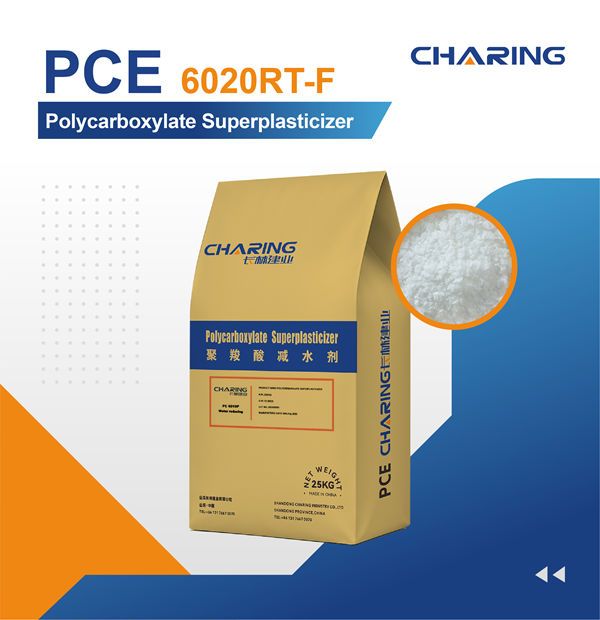
PC 6020RT is our high slump-retention PCE, available as flake (F) or powder (P).
| Property | Flake (6020RT-F) | Powder (6020RT-P) |
| Monomer | EPEG | EPEG |
| Active Content | 97% to 100% | 97% to 100% |
| Water Reduction | ≥ 15% | ≥ 15% |
| Slump Retention | ≥ 90 minutes | ≥ 90 minutes |
| Dosage | 0.05% to 0.3% of binder | 0.01% to 0.7% of binder |
| Packing | 25 kg bag | 25 kg bag |
| Storage | Below 30 °C, keep dry | Below 30 °C, keep dry |
Note that the water reduction of 6020RT is lower than that of our main reducer, PC 6010. This is intentional. 6020RT is not designed to perform the principal water reduction; its role is to sustain the slump over time.
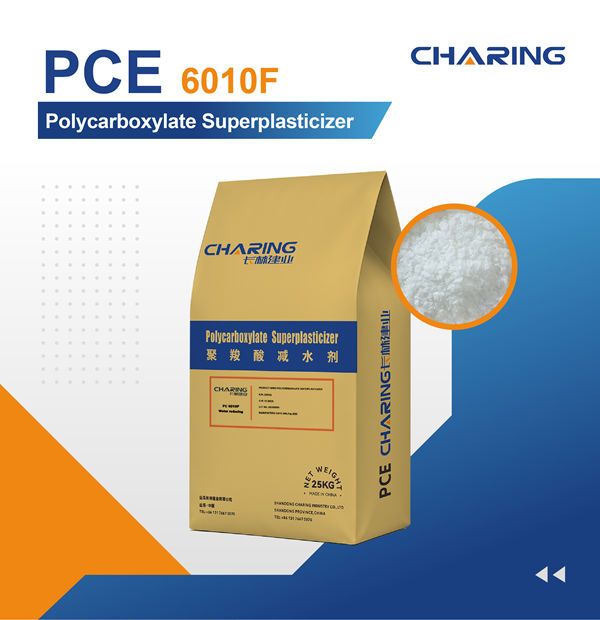
PC 6020RT is not intended to be used alone. It is combined with a main water reducer, PC 6010.
| PC 6010 : PC 6020RT | Slump-Retention Share | Typical Situation |
| 9 : 1 | 10% | Lower retention demand |
| 8 : 1 to 5 : 1 | 11% to 17% | A sensible starting point |
| 5 : 1 to 3 : 1 | 17% to 25% | Long transport, hot weather, large pours |
The correct ratio depends on two factors:
1.How long the slump must be maintained. Longer transport or higher temperatures call for more 6020RT.
2.The cement itself. Different cements adsorb PCE at different rates.
There is no single universal number. Test with your own cement and sand. Begin in the middle of the range and adjust upward or downward as required. The reason for testing is that C3A content, clay in the sand, and temperature all influence how quickly the concrete stiffens, and no reference table can account for your specific conditions.
One point requires attention when using 6020RT.
A high slump-retention PCE can draw additional air into the mix, and excessive air reduces strength. In practice, therefore, PC 6020RT is frequently used together with a defoamer — this is standard practice reported by our customers.
The procedure is straightforward: measure the air content, then add a small amount of defoamer to bring it back within range. Do not omit this step, as it can mean the difference between sound concrete and weak concrete.
Use a high slump-retention PCE whenever the concrete must remain workable for an extended period:
| Situation | Why Retention Is Needed |
| Long Transport | Slump falls during the journey |
| Hot Weather | Hydration accelerates, slump drops faster |
| High-Rise Pumping | Concrete waits in the line before placing |
| Large Pours | The pour takes hours to complete |
| Self-Compacting Concrete | Must flow for a sustained period |
If the concrete is placed within 30 minutes under mild conditions, a standard reducer is sufficient and 6020RT may not be necessary.
When concrete misbehaves, observe when the problem appears.
| Symptom | Timing | Cause | Remedy |
| Concrete stiff from the start | Immediately | Clay or cement adsorbs the reducer at once | Raise the main reducer, PC 6010 |
| Was good, then slumped fast | After 30 min | PCE became buried later | Add PC 6020RT |
| Weak Mix, Visible Bubbles | Any time | Air content too high | Add a defoamer |
This timing-based diagnosis identifies which admixture to adjust, and is more reliable than guesswork.
Is a high slump-retention PCE simply a reducer plus a retarder?
No. It is a reducer with a time-release design. It does not retard the set, whereas a retarder does.
Can 6020RT be used alone?
No. Use it together with PC 6010. 6020RT sustains the slump; 6010 provides the principal water reduction.
What ratio should I use?
Start around 8:1 to 5:1, then test with your own cement and adjust for your transport time and temperature.
Does 6020RT delay the final set?
A well-designed high slump-retention PCE should not — that is precisely the difference from a retarder. Confirm with your own mix test.
Why is my concrete weak when I use it?
Check the air content. 6020RT can entrain air, so add a defoamer.
Does it perform in hot weather?
Yes. Hot weather accelerates slump loss, so a higher proportion of 6020RT may be required.
For a complete overview of every concrete admixture and when to use each, read Concrete Admixtures: The Complete Guide.
To learn how a set retarder works, read What Is a Concrete Set Retarder?.
To learn how to compound a PCE admixture, read How to Compound a Polycarboxylate Superplasticizer (PCE) Admixture.

E-mail: sdcharing@sdcharing.com
Phone: +86 131 7667 0070
WhatsApp: +8615066133527
Add.: No.605-606,NO1 BUILDING,WANGYUE ZHIGU INDUSTRY PARK,NO.1919 WANGYUE ROAD, SHIZHONG AREA,JINAN CITY, SHANDONG PROVINCE,CHINA