- Home
- Products +
- Industries +
- About Us +
- News
- Contact Us

- Home
- Products
- Industries
- About Us
- News
- Contact Us
Oct. 22, 2026
Concrete Admixture Technical Guide · No. 27
Concrete gets stronger as you use less water — but only if it stays workable. That is exactly what a polycarboxylate superplasticizer (PCE) does: it lets you cut the water-cement ratio while keeping the mix fluid. This guide explains the water-cement ratio, why it controls strength, and how a PCE unlocks both at once.
The water-cement ratio (w/c) is the weight of water divided by the weight of cement.
| Ratio | What It Means |
| 0.50 | 0.50 kg of water for every 1 kg of cement |
| 0.40 | 0.40 kg of water per 1 kg of cement |
| 0.30 | 0.30 kg of water per 1 kg of cement |
A lower number means less water — and, up to a point, stronger concrete. The w/c ratio is the single most important number in a mix design, because it predicts the strength more reliably than almost anything else.
Two things are true about water in concrete, and they pull in opposite directions.
1. Water is needed for hydration. Cement only needs about 0.23–0.25 kg of water per kg of cement to react fully. This chemically bound water becomes part of the solid.
2. Extra water becomes pores. Any water above that minimum is there only to make the mix workable. After the concrete hardens, that extra water evaporates and leaves behind a network of capillary pores.
The relationship is direct: more water → more pores → lower strength. This is Abrams' law — strength falls as the water-cement ratio rises.
| Water-Cement Ratio | Result |
| Low (e.g. 0.30–0.35) | Dense, few pores, high strength |
| High (e.g. 0.50–0.60) | Porous, weaker, more permeable |
Here is the catch. Water does two jobs at once:
1.It hydrates the cement (only ~0.23–0.25 is needed).
2.It lubricates the mix so it can be placed and finished.
If you simply remove water to lower the w/c ratio, the concrete becomes stiff and unworkable — it cannot be placed. That was the old trade-off: stronger meant drier and harder to work.
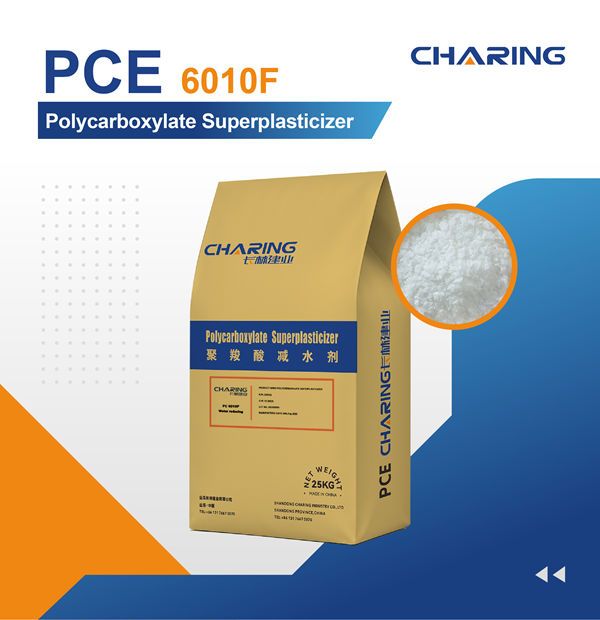
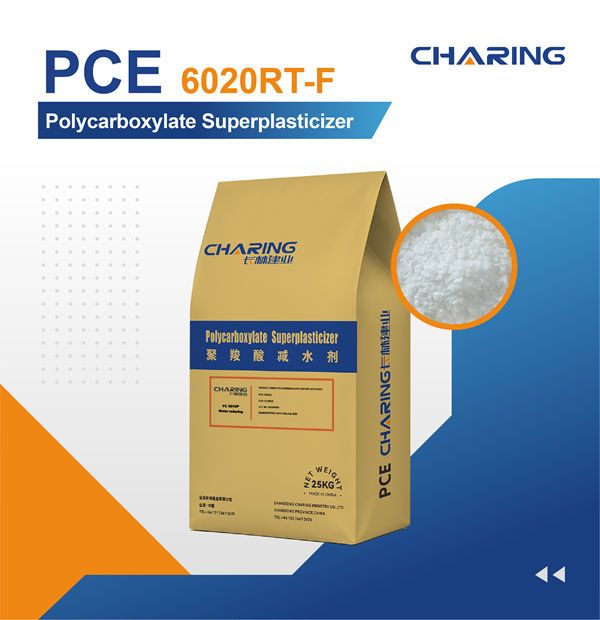
A polycarboxylate superplasticizer (PCE) separates the two jobs. It disperses the cement grains so the mix flows with less water. In effect, it replaces water as the "lubricant" — so you can cut the water without losing workability.
| Without PCE | With PCE |
| Need high water for flow | Flows at low water |
| High w/c, porous, weaker | Low w/c, dense, stronger |
| Same strength, more cement | Same strength, less cement |
A modern PCE has a water reduction rate of 25%–35%. That means it removes roughly a quarter to a third of the mixing water while keeping the same slump — and that water reduction converts directly into higher strength or cement savings.
The right w/c ratio depends on the strength and exposure you need. These are typical ranges, not fixed rules.
| Target | Typical w/c Range |
| General-purpose (C25–C30) | 0.45–0.55 |
| Structural (C40–C50) | 0.35–0.45 |
| High-strength (C60+) | 0.30–0.35 or lower |
The exact value always depends on the cement, the aggregates and the admixture — so run a trial mix rather than copying a number.
Lowering the w/c ratio is not a race to zero. If the ratio goes too low, new problems appear.
| Problem | What Happens |
| Segregation | Mix is too dry, fines and coarse aggregate separate |
| Bleeding | Imbalance releases water to the surface |
| Hard to pump | Stiff mix blocks the pump line |
| Poor finish | Surface cannot be troweled smooth |
The goal is not "as little water as possible" but "as little water as possible while still workable" — and that is precisely what a PCE is designed to deliver.
The water-cement ratio is the heart of concrete mix design. Less water means stronger, denser concrete — but only if the mix stays workable. A polycarboxylate superplasticizer is what makes both possible at the same time: it cuts water by 25%–35% while keeping the slump, so you get higher strength or lower cement cost without sacrificing placeability.
Why does less water make concrete stronger?
Only about 0.23–0.25 kg of water per kg of cement is needed for hydration. Extra water evaporates later and leaves pores, which weaken the concrete.
What is a good water-cement ratio?
General-purpose concrete is typically 0.45–0.55, structural 0.35–0.45, and high-strength 0.30–0.35 or lower. The exact value depends on the cement, aggregates and admixture.
How does a superplasticizer lower the water-cement ratio?
It disperses the cement grains so the mix flows with less water. A modern PCE removes 25%–35% of the mixing water while keeping the same workability.
Can the water-cement ratio be too low?
Yes. Too little water causes segregation, bleeding, pumping difficulty and poor finish. The goal is minimum water while still workable.
To see the right PCE dosage for different concrete, read How Much Polycarboxylate Superplasticizer (PCE) Do You Need?.
For a complete overview of every concrete admixture and when to use each, read Concrete Admixtures: The Complete Guide.
To choose between the PCE models, read Which Polycarboxylate Superplasticizer (PCE) Should You Choose?.

E-mail: sdcharing@sdcharing.com
Phone: +86 131 7667 0070
WhatsApp: +8615066133527
Add.: No.605-606,NO1 BUILDING,WANGYUE ZHIGU INDUSTRY PARK,NO.1919 WANGYUE ROAD, SHIZHONG AREA,JINAN CITY, SHANDONG PROVINCE,CHINA