- Home
- Products +
- Industries +
- About Us +
- News
- Contact Us

- Home
- Products
- Industries
- About Us
- News
- Contact Us

Sep. 20, 2026
Concrete Admixture Technical Guide · No. 06
The usual dose is 0.15% to 0.4% of binder weight, by active polycarboxylate superplasticizer (PCE). But this is not a fixed number — the cement, the sand, and the temperature all change it. This guide gives the starting point, then explains how to adjust it.
| Concrete Grade | Active PCE Dose (% of Binder) | Flake (kg/m³) |
| C20–C25 | 0.15%–0.20% | 0.42–0.64 |
| C30–C40 | 0.18%–0.25% | 0.58–1.0 |
| C50–C60 | 0.25%–0.35% | 1.0–1.7 |
| Above C60 | 0.30%–0.40% | 1.6–2.4 |
This is only a starting point. The sections below explain why the real number moves, and how to adjust it.
PCE works by adsorbing onto the cement particles. Its carboxyl groups hold on, while its side chains separate the particles — this is what makes the mix flow.
The dose required therefore depends on one thing: how much PCE is consumed before it can do its work. Three factors consume PCE.
| Factor | Mechanism | Effect on Dose |
| Cement C3A content | High tricalcium aluminate (C3A) reacts fast and adsorbs PCE in the first minutes | High-C3A cement needs a higher dose |
| Sand Clay | Clay, especially montmorillonite, absorbs the PCE side chains between its layers (intercalation) | High-clay sand needs a higher dose |
| Temperature | Heat accelerates hydration, consuming PCE faster | Hot weather needs a higher dose |
The rule is straightforward: the real dose = the starting dose + what the cement, sand, and temperature consume.
Water reduction does not rise forever — there is a limit.
At a low dose, the PCE covers only part of the cement surface, so dispersion is weak.
As the dose rises, more surface is covered and water reduction climbs.
Beyond a certain point — the saturation dose — the surface is full, and adding more PCE does not reduce more water.
Worse, an overdose brings its own problems:
| Effect of Overdose | What You See |
| Bleeding | Water separates on the surface |
| Segregation | Paste separates from the aggregate |
| Delayed Setting | Concrete sets late or stays soft |
The rule is therefore: raise the dose up to the saturation point, but not past it. Test in small steps to find where the curve flattens.
Do not guess. Observe the concrete.
| Symptom | Timing | Remedy |
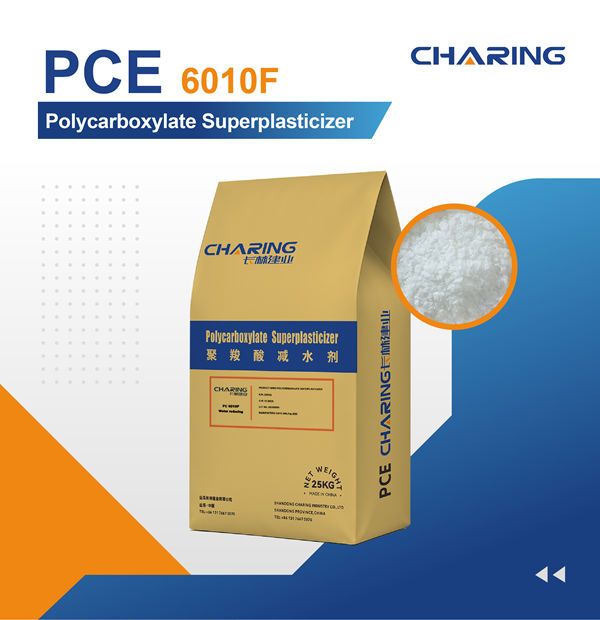
| Concrete Stiff or Dry | At the very start | Raise the standard reducer (PC 6010) |
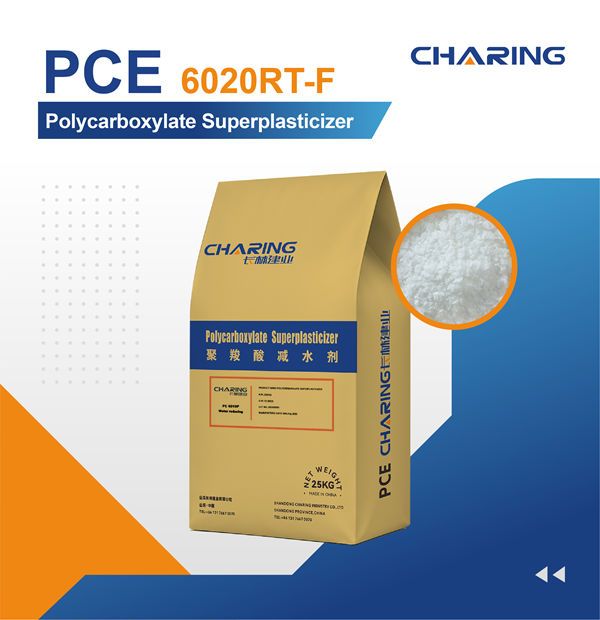
| Fine at first, then loses slump fast | After about 30 minutes | Raise the high slump-retention PCE (PC 6020RT) |
Test each change in small steps. The timing tells you which one to raise.
There is one further factor that affects the real dose: the form of the PCE.
Liquid PCE is supplied in many strengths — 10%, 20%, 40%, 50%. If the strength is unknown, the dose is wrong. The same amount of active PCE can look very different:
| Active PCE | Flake (≈100%) | 10% Liquid | 20% Liquid | 40% Liquid | 50% Liquid |
| 0.5 kg | 0.5 kg | 5 kg | 2.5 kg | 1.25 kg | 1 kg |
With liquid, you must know the concentration, or the dose is wrong.
Flake is 97% to 100% active, so one number is enough. Weigh the flake and you know the dose — no conversion, no guessing the supplier's strength.
This is not merely convenient. A supplier cannot hide water in flake. With liquid, a batch labelled "50%" might in fact be 45%, which makes the dose wrong and the concrete suffer. Flake removes that risk.
You want C30 concrete. The table suggests starting at about 0.20% active.
Your binder is 400 kg/m³, so you need:
400 × 0.20% = 0.8 kg of active PCE per m³.
That is 0.8 kg of flake. Weigh it, dissolve it, add it.
If the concrete is stiff at the start, raise to 0.22% or 0.25%. If it loses slump after 30 minutes, add a small amount of PC 6020RT. Test each step.
PCE allows the use of less water at the same workability. Less water means higher strength.
| Concrete | Water Without PCE | Water with PCE |
| C50–C60 | 170–190 kg/m³ | 120–150 kg/m³ |
What is the usual PCE dose?
0.15% to 0.4% of binder weight, by active content. Higher grades use more.
Why is the dose not a fixed number?
Because the cement, the clay in the sand, and the temperature all consume PCE. The dose must cover what they consume.
How do I know whether to raise the standard reducer or the high slump-retention PCE?
Observe the timing. Stiff at the start means raise the standard reducer. Rapid slump loss after 30 minutes means raise the high slump-retention PCE.
Why does clay raise the dose so much?
Montmorillonite clay absorbs the PCE side chains between its layers. A small amount of clay consumes a large amount of PCE.
Is flake dosing easier than liquid?
Yes. Flake is 97% to 100% active, so one number is enough. Liquid strength varies, and you must know it or the dose is wrong.
Do I still need a trial mix?
Yes. Start with the table, then test. Every cement and sand is different.
For a complete overview of every concrete admixture and when to use each, read Concrete Admixtures: The Complete Guide.
To see why PCE sometimes underperforms, read Why Does Polycarboxylate Superplasticizer (PCE) Sometimes Not Work?.
To choose between the PCE models, read Which Polycarboxylate Superplasticizer (PCE) Should You Choose?.

E-mail: sdcharing@sdcharing.com
Phone: +86 131 7667 0070
WhatsApp: +8615066133527
Add.: No.605-606,NO1 BUILDING,WANGYUE ZHIGU INDUSTRY PARK,NO.1919 WANGYUE ROAD, SHIZHONG AREA,JINAN CITY, SHANDONG PROVINCE,CHINA