- Home
- Products +
- Industries +
- About Us +
- News
- Contact Us

- Home
- Products
- Industries
- About Us
- News
- Contact Us

Sep. 28, 2026
Concrete Admixture Technical Guide · No. 11
Polycarboxylate superplasticizer (PCE) is a highly effective water reducer. Yet the same dose sometimes gives very different results. The reason is usually the cement, the sand, or the temperature. This guide explains the three main causes and how to correct them.
PCE adsorbs onto the cement particles: its carboxyl groups hold onto the particle surface, while its long side chains separate the particles. This dispersion is what makes the mix flow.
The key word is "adsorb" — PCE only works when it is on the cement. Anything that prevents adsorption, or consumes the PCE, reduces the effect.
Cement is not uniform. Two factors matter most for PCE: the C3A content and the sulfate content.
Tricalcium aluminate (C3A) is the most reactive phase of the cement. It reacts with water very quickly and adsorbs a large amount of PCE in the first minutes. A high-C3A cement therefore consumes more PCE early, leaving less to disperse the rest of the mix — the result is less water reduction and faster slump loss.
Sulfate competes with PCE for the particle surface. Too little sulfate and the PCE over-adsorbs, which can cause slump loss; too much sulfate and it fights the PCE. The sulfate level must sit within the correct window.
What to do. If a cement is difficult, test a higher dose first, or use a PCE designed for that cement. A high slump-retention PCE also helps hold the slump on difficult cement.
Clay is the greatest enemy of PCE, and it hides in the sand.
| Factor | Mechanism | Severity |
| Montmorillonite Clay | Layered structure absorbs the PCE side chains between its layers (intercalation) | sMot severe |
| Kaolin Clay | Milder structure, lower absorption | Mild |
| Stone Powder (machine-Made Sand) | Fine particles raise the PCE demand | Moderate |
A small amount of clay can consume a large amount of PCE — the side chains are "swallowed" between the clay layers, leaving the PCE with nothing to disperse the cement. The type of clay matters, not just the amount.
What to do. Many sites cannot wash the sand — there is no water, space or equipment. The practical solution is to adjust the two water reducers.
| Symptom | Timing | Remedy |
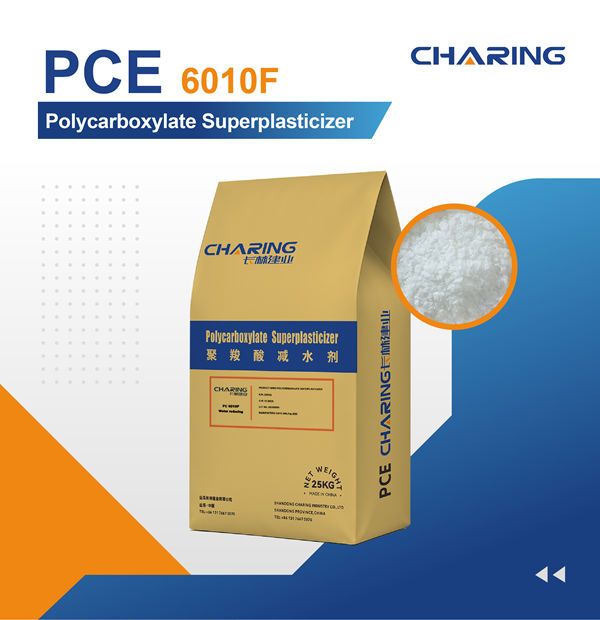
| Concrete wrong from the start | Immediately | Raise the standard reducer (PC 6010) |
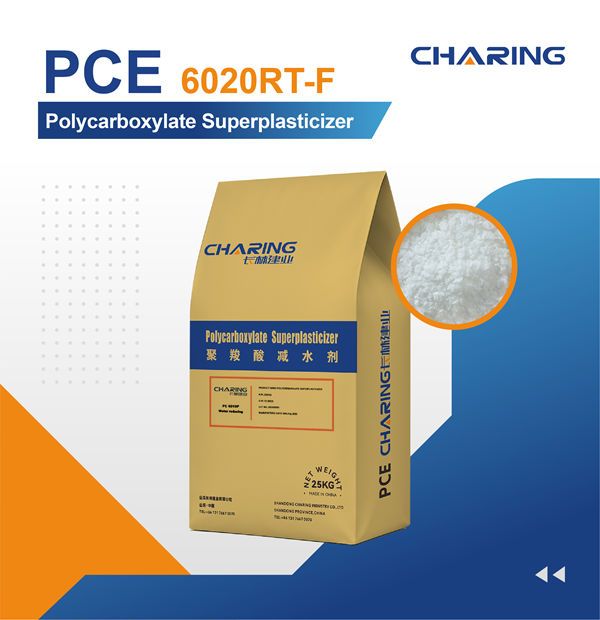
| Fine at first, then loses slump fast | After ~30 minutes | Raise the high slump-retention PCE (PC 6020RT) |
You do not need to wash the sand — adjust the two water reducers instead. Always test to determine which one to raise, and by how much.
Heat accelerates everything: cement hydrates faster and slump drops faster. In hot weather the PCE is consumed more quickly, so a higher dose — or a high slump-retention PCE — is required.
Do not guess. Observe the concrete and read the timing.
| Step | Check | Action |
| 1 | Immediately after mixing | If stiff or dry, raise the standard reducer |
| 2 | After about 30 minutes | If slump drops fast, raise the high slump-retention PCE |
| 3 | Temperature | Hot days consume PCE faster; more of both may be needed |
The timing tells you which water reducer to raise.
PCE is powerful, but sensitive. Cement, clay and temperature all change the required dose. Test with your own materials — do not copy a dose from another site.
Why does the same PCE dose give different results?
Because the cement, sand and temperature differ. PCE is sensitive to all three.
What is the biggest problem for PCE?
Clay in the sand. Montmorillonite absorbs the PCE side chains.
Why does high-C3A cement need more PCE?
C3A adsorbs a large amount of PCE very quickly, leaving less for the rest of the mix.
Does temperature change the dose?
Yes. Hot weather consumes PCE faster. You may need more, or a high slump-retention PCE.
How do I find the cause of a bad mix?
Observe the timing. Stiff at the start means raise the standard reducer; rapid slump loss after 30 minutes means raise the high slump-retention PCE.
For a complete overview of every concrete admixture and when to use each, read Concrete Admixtures: The Complete Guide.
To see the right dosage for different concrete, read How Much Polycarboxylate Superplasticizer (PCE) Do You Need?.
To see how machine-made sand affects the dose, read Machine-Made Sand and Clay.

E-mail: sdcharing@sdcharing.com
Phone: +86 131 7667 0070
WhatsApp: +8615066133527
Add.: No.605-606,NO1 BUILDING,WANGYUE ZHIGU INDUSTRY PARK,NO.1919 WANGYUE ROAD, SHIZHONG AREA,JINAN CITY, SHANDONG PROVINCE,CHINA