- Home
- Products +
- Industries +
- About Us +
- News
- Contact Us

- Home
- Products
- Industries
- About Us
- News
- Contact Us

Oct. 08, 2026
Concrete Admixture Technical Guide · No. 16
Choosing a PCE (polycarboxylate superplasticizer) involves two decisions, not one:
1.Which performance type — standard reduction, early strength, or slump retention.
2.Which form — flake (F) or powder (P).
Getting both right is what separates a specialist admixture company from a price list. Here is how to choose.
| Model | Type | Water Reduction | Key Strength | Typical Dosage |
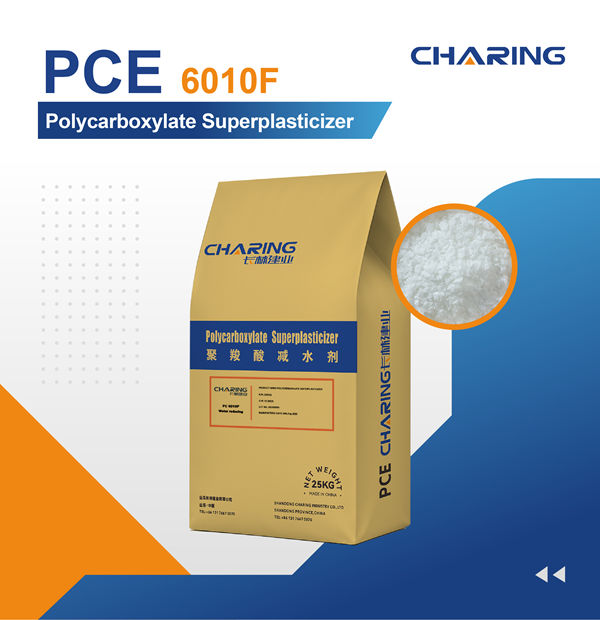
| PC 6010F / PC 6010P | Standard high-range reducer | ≥ 25% | High water reduction, all-round | 0.1%–1.5% of binder |
| PC 6030E | Early-strength reducer | ≥ 25% | 1-day strength ratio ≥ 180% | 0.2%–0.5% of binder |
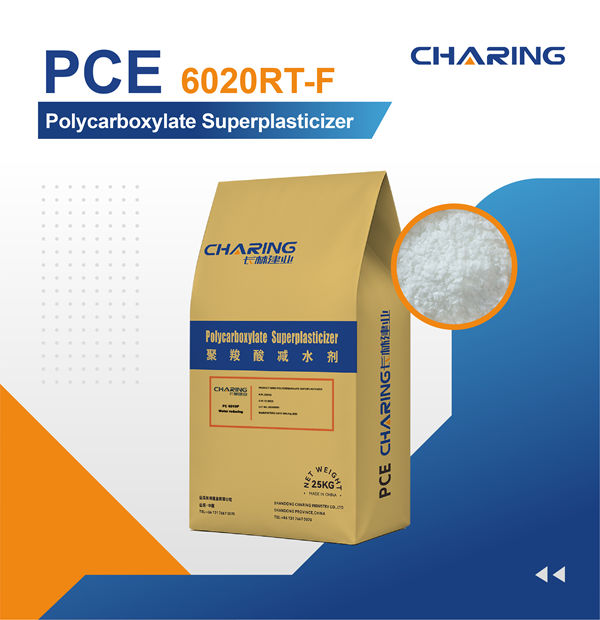
| PC 6020RT-F / PC 6020RT-P | High slump-retention reducer | ≥ 15% | Slump held ≥ 90 minutes | F: 0.05%–0.3% / P: 0.01%–0.7% |
All are built on EPEG monomer, with an active content of 97% to 100%.
PC 6010 — the workhorse
The standard high-range water reducer, and the main product for most concrete. It delivers the core benefit — high water reduction and high strength — across a wide dosage range, because a single reducer must serve many cements.
When to use it. Almost every ordinary ready-mix or precast concrete under normal conditions.
PC 6030E — early strength
Built with amino and sulfonic acid groups that promote early cement hydration, it reaches a 1-day strength ratio of 180% or more on C25 concrete, with chloride ≤ 0.06% (safe for reinforced concrete).
| Age | Strength Ratio (C25) |
| 1 day | ≥ 180% |
| 3 days | ≥ 170% |
| 7 days | ≥ 145% |
| 28 days | ≥ 120% |
When to use it. Precast components, cold weather, and emergency repair.
PC 6020RT — high slump retention
A slow-release reducer — not a standard reducer with a retarder added. Part of its acid groups are protected as esters, which hydrolyse slowly to sustain the slump without delaying the set.
When to use it. As an auxiliary product combined with PC 6010, at a ratio of 9:1 to 3:1, for long transport, hot weather and large pours. It is often used with a small amount of defoamer.
The same performance is available in two forms, and the choice is about cost and dissolving.
| Form | What It Is | Cost | Best For |
| F (flake) | Cut directly, no milling step | Most economical | Customers who can dissolve it themselves with simple equipment |
| P (powder) | Flake milled to powder (not spray-dried) | Slightly higher (milling adds cost) | Customers who want fast, easy dissolving |
The logic is simple:
If the customer has a small dissolving setup — a tank, pump and stirrer — the flake (F) is the best choice. It skips the milling step, so it is the most economical.
If the customer wants instant dissolving and accepts the slightly higher price, the powder (P) is the better choice. Milling adds a step and a cost, but the powder dissolves very quickly.
Note that our powder is flake-milled, not spray-dried — so it keeps full performance.
| Your Situation | Performance | Form |
| Ordinary concrete, has dissolving equipment | PC 6010 | F (flake) |
| Ordinary concrete, wants instant dissolving | PC 6010 | P (powder) |
| Fast demoulding, cold weather, repair | PC 6030E | — |
| Long transport, hot weather, large pour | PC 6010 + PC 6020RT | F or P, as above |
The form is a separate choice from the performance type — you decide each independently, based on how the customer will use the product.
Mistaking 6020RT for "reducer + retarder". It is a slow-release reducer, not a reducer with a retarder mixed in.
Using 6020RT alone. It must be combined with PC 6010.
Assuming more dose is always better. Beyond the saturation point, extra PCE causes bleeding, segregation or delayed setting.
Ignoring the form. Flake and powder are the same chemistry, but the cost and the dissolving behaviour differ.
Ignoring air content. A high slump-retention PCE entrains air; control it with a defoamer.
Cement differs, sand differs, and so does the way each customer works. Some dissolve their own liquid; some want a powder that dissolves the moment it touches water. There is no single model, form or dose that fits everyone.
A specialist admixture company offers the judgment to match all three — performance, form and dose — to the specific job. That is the difference between concrete that works, and concrete that works every time.
Which model do I start with?
PC 6010 for ordinary concrete. It is the workhorse.
Should I choose flake or powder?
Flake is more economical if the customer can dissolve it themselves. Powder dissolves faster but costs slightly more (the milling step).
Is your powder spray-dried?
No. It is flake-milled, so it keeps full performance.
When do I need early strength?
Precast, cold weather and fast-track repair — choose PC 6030E.
When do I need slump retention?
Long transport, hot weather and large pours — add PC 6020RT to PC 6010.
Can 6020RT be used alone?
No. It is an auxiliary product, combined with PC 6010 at 9:1 to 3:1.
Do I need a defoamer with 6020RT?
Often yes, because a high slump-retention PCE entrains air.
For a complete overview of every concrete admixture and when to use each, read Concrete Admixtures: The Complete Guide.
To see what solid PCE is and how it works, read What Is Solid Polycarboxylate Superplasticizer (PCE)?.
To learn how a high slump-retention PCE works, read What Is a High Slump-Retention Polycarboxylate Superplasticizer (PCE)?.

E-mail: sdcharing@sdcharing.com
Phone: +86 131 7667 0070
WhatsApp: +8615066133527
Add.: No.605-606,NO1 BUILDING,WANGYUE ZHIGU INDUSTRY PARK,NO.1919 WANGYUE ROAD, SHIZHONG AREA,JINAN CITY, SHANDONG PROVINCE,CHINA