- Home
- Products +
- Industries +
- About Us +
- News
- Contact Us

- Home
- Products
- Industries
- About Us
- News
- Contact Us

Sep. 28, 2026
Concrete Admixture Technical Guide · No. 15
Fresh concrete always contains some air. A small amount is harmless, and in freezing climates it is even essential. But too much air weakens the concrete — and polycarboxylate superplasticizer (PCE) naturally entrains some air. Controlling air content is therefore a skill every PCE user should have.
| Effect | Benefit or Risk |
| Freeze–thaw Resistance | Tiny, well-spaced bubbles absorb the pressure of freezing water — essential in cold climates |
| Workability | Bubbles act like ball bearings, making the mix easier to place |
| Strength | Every extra 1% of air reduces compressive strength by roughly 5% |
| Surface Finish | Too much air leaves a rough or porous surface |
Air is therefore a trade-off: good for durability and workability, but bad for strength.
PCE is a polymer surfactant. Like all surfactants, it lowers the surface tension of water and stabilises the bubbles that form during mixing, so the bubbles do not simply collapse.
Two points follow:
1.Most PCE will entrain a little air even when you do not want it.
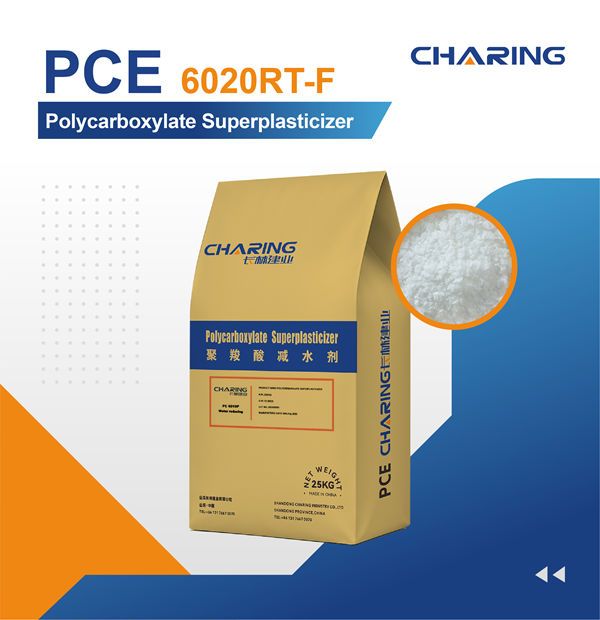
2.A high slump-retention PCE (such as PC 6020RT) tends to entrain more air, which is why it is often used with a defoamer.
| Concrete Type | Typical Target Air Content |
| Ordinary concrete (no freeze–thaw exposure) | 2% to 4% |
| Freeze–thaw Resistant Concrete | 4% to 7% |
| High-Strength Concrete | Usually kept low (≤ 2%) to protect strength |
The exact target depends on the maximum aggregate size and the exposure, but these ranges are a sound guide.
The air content is adjusted with two small additives:
| Additive | What It Does | Typical Dosage |
| Air-Entraining Agent | Creates fine, stable bubbles for freeze–thaw resistance | 0.005% to 0.05% of cement weight |
| Defoamer | Breaks down excess or unwanted air | 0.01% to 0.05% of cement weight |
If the air is too high, add a defoamer.
If the concrete must resist freeze–thaw and the air is too low, add an air-entraining agent.
Measure the air content, then adjust — do not dose blind.
| Symptom | Likely Cause | Remedy |
| Concrete Weaker than Expected | Air content too high | Add a defoamer |
| Rough, Porous Surface | Too much air, or large bubbles | Add a defoamer, or check the PCE dosage |
| Freeze–thaw Damage in Service | Air content too low, or bubbles poorly spaced | Add an air-entraining agent |
| Air creeps up with a high slump-retention PCE | Retention PCE entrains air | Use a defoamer together with the retention PCE |
Air content is not an accident — it is a variable you can control. Because PCE entrains air on its own, always measure it in the trial mix and adjust with a defoamer or an air-entraining agent as needed. A few tenths of a percent make a real difference to strength.
Does PCE always entrain air?
Most PCE entrains a little. A high slump-retention PCE tends to entrain more.
How much does air affect strength?
Each 1% of extra air reduces compressive strength by roughly 5%.
What air content should I aim for?
2% to 4% for ordinary concrete, 4% to 7% for freeze–thaw resistant concrete.
How do I reduce air?
Add a small amount of defoamer and re-measure.
How do I increase air for freeze–thaw resistance?
Add an air-entraining agent.
Why do I need a defoamer with PC 6020RT?
Because a high slump-retention PCE entrains more air, and excess air lowers strength.
For a complete overview of every concrete admixture and when to use each, read Concrete Admixtures: The Complete Guide.
To learn how a high slump-retention PCE works, read What Is a High Slump-Retention Polycarboxylate Superplasticizer (PCE)?.
To learn how to compound a PCE admixture, read How to Compound a Polycarboxylate Superplasticizer (PCE) Admixture.

E-mail: sdcharing@sdcharing.com
Phone: +86 131 7667 0070
WhatsApp: +8615066133527
Add.: No.605-606,NO1 BUILDING,WANGYUE ZHIGU INDUSTRY PARK,NO.1919 WANGYUE ROAD, SHIZHONG AREA,JINAN CITY, SHANDONG PROVINCE,CHINA