- Home
- Products +
- Industries +
- About Us +
- News
- Contact Us

- Home
- Products
- Industries
- About Us
- News
- Contact Us
Sep. 14, 2026
Concrete Admixture Technical Guide · No. 01
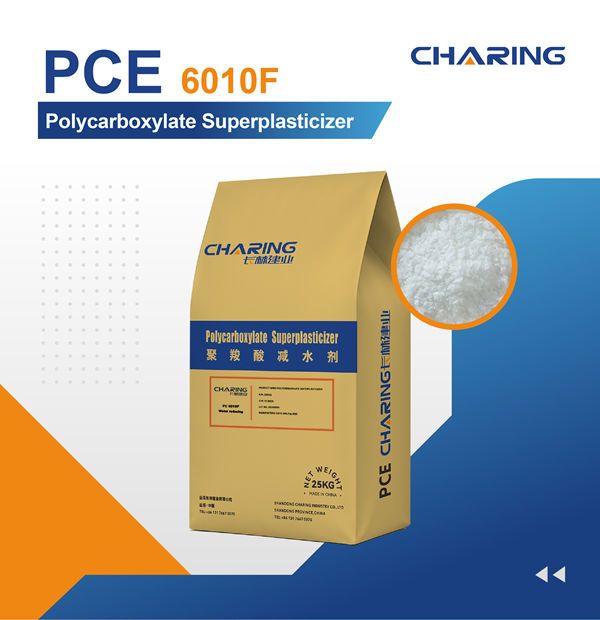
Solid polycarboxylate superplasticizer (PCE) is a dry, flake-shaped water reducer. Dissolve it in water and it becomes a liquid admixture — which you can prepare yourself, on site.
This guide explains what it is, how it works, how it is made, and why it is different.
What Is PCE?
PCE is a water reducer for concrete and mortar. A water reducer is an admixture: add a small amount, and the mix flows better. You can then use less water, so the concrete stays strong.
PCE is the most common water reducer today, having replaced older types such as naphthalene-based water reducers.
How PCE Works: The Comb Structure
PCE is a comb-shaped polymer.
The backbone carries carboxyl (acid) groups, which anchor the molecule to the cement particle.
The side chains are long polyether chains that extend into the water and separate the cement particles.
The carboxyl groups anchor the PCE; the side chains provide the separation. Together they disperse the cement particles, so the mix flows with less water. This is why PCE is so efficient — a small amount disperses a large amount of cement.
PCE disperses through two mechanisms at once, which is why it outperforms the older reducers:
1.Electrostatic repulsion — the carboxyl groups give the cement grains a negative charge, so the grains repel one another.
2.Steric hindrance — the long side chains act as physical spacers that keep the grains apart.
Older reducers such as naphthalene-based products rely on electrostatic repulsion alone. PCE adds the steric layer on top, which is why it can reach a water reduction of 30% or more, while naphthalene-based reducers typically stop around 20%.
The Three Forms of PCE
| Form | Active Content | Notes |
| Liquid Mother Liquor | 40% to 55% | The most common form; the rest is water |
| Powder | Varies | Two types — see below |
| Solid Flake (tablet) | 97% to 100% | The focus of this guide |
Powder comes in two kinds:
| Powder Type | How It Is Made | Performance |
| Spray-Dried | Liquid dried with hot air | Heat can damage the polymer; may lose performance |
| Flake-Milled | Solid flake crushed into powder | Keeps full performance |
Know which powder you are buying.
How the Flake Is Made
The flake is made in two steps:
1.Bulk polymerization — the monomers react directly, with no water and no solvent.
2.Low-temperature flaking — the solid polymer is cut into flakes at low temperature.
These two steps matter because heat and water can both damage PCE. The polyether side chains are heat-sensitive; water allows the molecule to drift and feeds bacteria. Bulk polymerization avoids water, and low-temperature flaking avoids heat, so the molecule remains intact.
Why Flake Is the Best Solid Form
The solid forms are not equal.
| Form | Performance | Notes |
| Flake | Full | No water, 97% to 100% active |
| Flake-Milled Powder | Full | One extra milling step |
| Spray-Dried Powder | Weaker | Heat damages the molecule |
Flake also outperforms liquid over time. Liquid carries water, so its molecule can drift and its water can grow bacteria. Flake is anhydrous and remains stable — you mix it fresh when needed.
The Numbers
| Property | Value |
| Active Content | 97% to 100% |
| Base Monomer | EPEG polycarboxylate ether |
| Appearance | Buff or off-white flake |
| Shelf Life | About one year, dry and cool |
Our Models
| Model | Function |
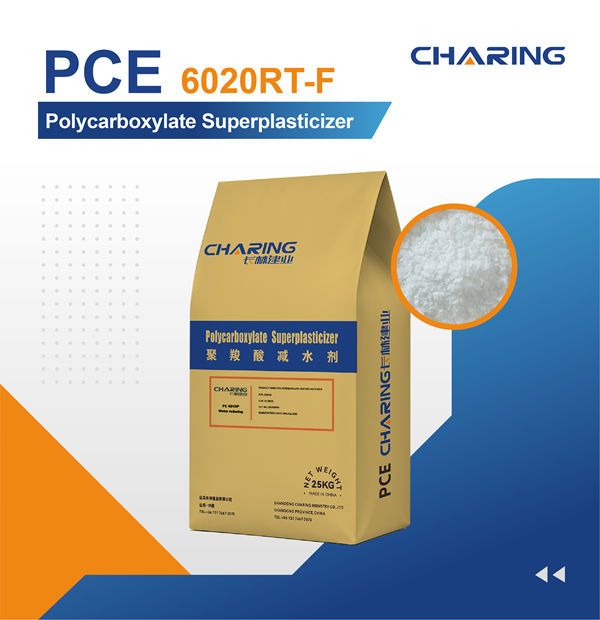
| PC 6010F (flake) / PC 6010P (powder) | Standard high water reduction |
| PC 6030E | Early strength |
| PC 6020RT | High slump retention, used with the 6010 series |
How to Use It
1.Dissolve the flake in water. A simple tank, pump and stirrer is sufficient.
2.Dose at 0.1% to 0.5% of cement weight, by active content.
3.Run a trial mix first — cement and sand differ by region.
Do not mix flake PCE with naphthalene-based water reducers.
Where It Is Used
Ready-mix concrete
Precast concrete (piles, panels, segments)
High-strength and self-compacting concrete
Dry-mix mortar (grouts, self-leveling, tile adhesive) — these mixes need a powder, so mill the flake first
Ultra-high-performance concrete (UHPC)
Standards
Check the standard your market requires:
| Market | Standard |
| China | GB 8076, JG/T 223 |
| Europe | EN 934-2 |
| United States | ASTM C494 |
FAQ
How does PCE work?
It is a comb-shaped polymer. Its carboxyl groups anchor to the cement, and its long side chains separate the particles.
Is flake the same as powder?
No. Flake is made without heat. Spray-dried powder passes through hot air and can lose performance; flake-milled powder keeps full performance.
Why is flake better than liquid over time?
Liquid carries water, so its molecule can drift and its water can grow bacteria. Flake is anhydrous, so it stays stable.
What is the active content of flake PCE?
97% to 100% — nearly all of it is active PCE.
What dosage should I use?
0.1% to 0.5% of cement weight, by active content. Run a trial mix first.
Can I use flake PCE in dry-mix mortar?
Yes. Mill the flake into powder first, since dry-mix mortar requires a powder.
How long can I store it?
About one year, if kept dry and cool. Avoid direct sun and high heat.
Related reading
For a complete overview of every concrete admixture and when to use each, read Concrete Admixtures: The Complete Guide.
To see how flake PCE is made and why it keeps full performance, read Bulk Polymerization vs Spray Drying.
To choose between the PCE models, read Which Polycarboxylate Superplasticizer (PCE) Should You Choose?.

E-mail: sdcharing@sdcharing.com
Phone: +86 131 7667 0070
WhatsApp: +8615066133527
Add.: No.605-606,NO1 BUILDING,WANGYUE ZHIGU INDUSTRY PARK,NO.1919 WANGYUE ROAD, SHIZHONG AREA,JINAN CITY, SHANDONG PROVINCE,CHINA