- Home
- Products +
- Industries +
- About Us +
- News
- Contact Us

- Home
- Products
- Industries
- About Us
- News
- Contact Us
Oct. 27, 2026
Concrete Admixture Technical Guide · No. 29
High-strength concrete — roughly C60 and above — is not ordinary concrete with more cement. It is built around one controlling number: a very low water-binder ratio. Achieving that ratio is impossible without a strong polycarboxylate superplasticizer (PCE). This guide explains the mix design, the mineral admixtures, and why the PCE is the part that makes high strength possible.
In most markets, concrete of C60 and above is considered high-strength, and C100 is near the top of what is routinely produced.
| Grade | Typical Water-Binder Ratio | Cementitious Material |
| C60 | 0.28–0.34 | 480–560 kg/m³ |
| C80 | 0.26–0.28 | 520–580 kg/m³ |
| C100 | 0.24–0.26 | 550–600 kg/m³ |
The strength grade climbs as the water-binder ratio falls — and that one relationship drives the whole design.
High-strength concrete is, above all, about removing water. As a rule of thumb, lowering the water-binder ratio by 0.02 raises the 28-day strength by about 5–10 MPa. The reason is the same as in normal concrete: less water leaves fewer capillary pores, and fewer pores mean a denser, stronger matrix.
But there is a catch — the same one every strong concrete faces: a low water-binder ratio makes the mix stiff and hard to place. Only a high-range water reducer can cut the water this far and still keep the concrete workable.
| Component | What It Does | Typical Guidance |
| Cement (P·O 52.5 or higher) | The main binder | 350–450 kg/m³, with mineral admixtures |
| Mineral admixtures | Fill pores, add late strength | 25–40% of total binder |
| Silica fume | Ultrafine filler + pozzolan | 5–10% (up to 12% for C100) |
| Coarse aggregate | Strong, clean stone | ≤ 20 mm, low clay |
| PCE superplasticizer | High water reduction | 0.15–0.35% of binder |
Two rules that separate high-strength from normal mix design:
1.The aggregate must be strong and clean. Coarse aggregate should have a crushing value of no more than 10%, and clay content under 0.5%. Weak or dirty aggregate caps the strength no matter how good the binder is.
2.The water-binder ratio is king. Everything else — cement, silica fume, admixture — is there to let you lower it without losing workability.
High-strength concrete rarely uses cement alone. Mineral admixtures do two jobs at once: they fill the fine pores, and they react slowly to add late strength.
| Admixture | Main Role |
| Silica fume | Ultrafine filler + pozzolanic reaction; boosts 28-day strength by ~15–30% |
| Ground granulated slag | Improves later strength and durability |
| Fly ash | Cuts heat of hydration, improves flow |
Silica fume is the key one for C80 and above. Its particles are far finer than cement, so they pack into the spaces between cement grains, densifying the matrix — and it reacts with the lime from hydration to form more C-S-H gel, the strength-giving phase.
This is where the admixture decides the outcome. High-strength concrete needs the maximum initial water reduction, because that is what gets you to the low water-binder ratio in the first place.
| Requirement | Why |
| Water reduction ≥ 28% (for C80+) | Needed to reach the low w/b ratio |
| High-reduction grade, not slump-retention | Priority is cutting water, not holding flow |
| Active content precise (> 95%) | A 3–5% drift changes w/b and can cost 5–15 MPa |
A polycarboxylate superplasticizer is the right tool because it gives 25–40% water reduction and disperses by steric hindrance, which works well with silica fume. This is where solid, precisely-dosed PCE has a real edge: because its active content is a stable 97–100%, the dose converts reliably into a predictable water-binder ratio — no guessing against a liquid of uncertain concentration.
For long transport, a small amount of slump-retention PCE can be added on top of the main reducer, but the foundation is always the high-reduction PCE.
Here is a real C50 mix (a step below full "high-strength", but the same principles), showing how the pieces fit:
| Ingredient | Amount (kg/m³) |
| Cement | 375 |
| Fly ash | 50 |
| Ground slag | 75 |
| Water | ~155 (w/b = 0.31) |
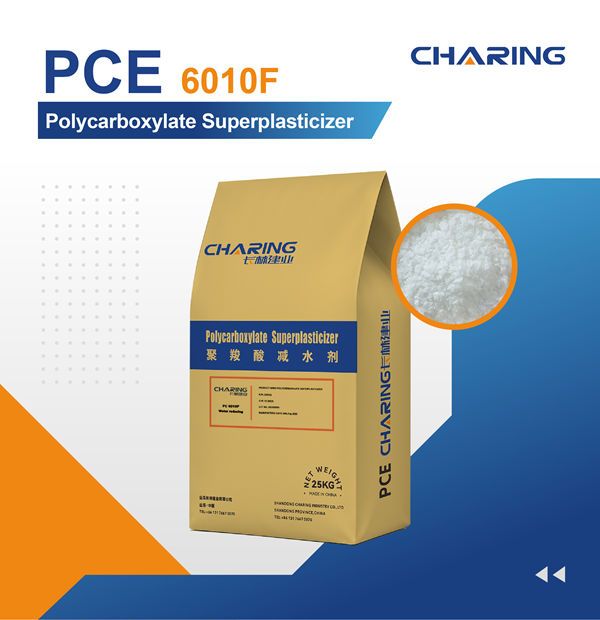
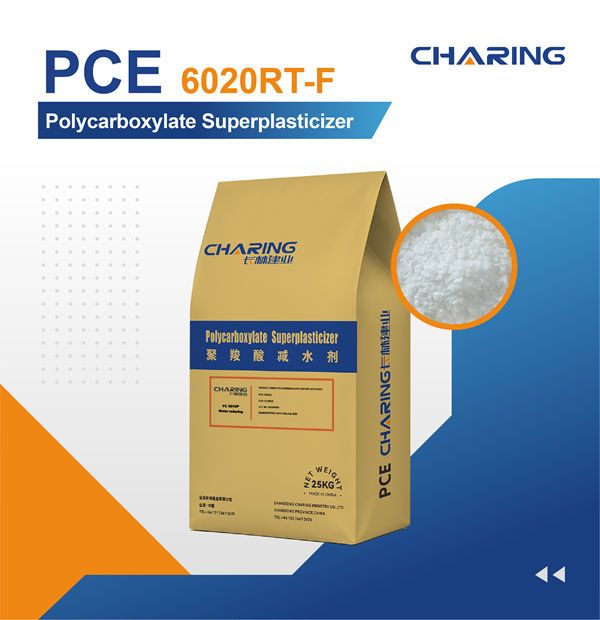
| PCE (PC 6010F + PC 6020RT, 4:1) | 0.30% of binder |
Total binder is 500 kg/m³ and the water-binder ratio is 0.31. To push this toward C60 and C80, you add silica fume (5–10%), raise the binder, and drive the water-binder ratio down toward 0.28–0.26 — with the PCE doing more work at each step.
High-strength concrete is less forgiving than normal concrete, so three things deserve attention.
| Point | Why It Matters |
| Heat of hydration | High binder content generates more heat; control the temperature rise |
| Early curing | Silica-fume mixes shrink early — keep them wet for 14+ days |
| Pumping | Low w/b mixes are stiff; a pump aid or careful slump control helps |
| Problem | Likely Cause | What to Do |
| Strength below target | Water-binder ratio too high | Reduce water, raise PCE dose |
| Early cracking | Silica fume + fast drying | Extend curing, cover early |
| Hard to pump | Mix too stiff | Check PCE dose, adjust slump |
| Sticky, hard to finish | Silica fume too high | Reduce silica fume, re-test |
What water-binder ratio does high-strength concrete need?
Roughly 0.28–0.34 for C60, 0.26–0.28 for C80, and 0.24–0.26 for C100. Lower is stronger, but only if the mix stays workable.
Why is a PCE essential for high-strength concrete?
Because only a high-range water reducer can cut the water-binder ratio this low while keeping the concrete placeable. For C80 and above, the water reduction should be 28% or more.
Do I need silica fume?
Not for every mix, but it is standard for C80 and above. It densifies the matrix and boosts 28-day strength by 15–30%.
Why does active content in the PCE matter so much?
Because the dose is calibrated to a precise water-binder ratio. A few percent of drift in active content changes the strength by several MPa.
To understand why less water makes stronger concrete, read Why Does Less Water Make Concrete Stronger? (The Water-Cement Ratio).
For a real C50 mix design in full detail, read Case Study: C50 Concrete with Flake PCE and High Slump-Retention Admixture.
To choose between the PCE models, read Which Polycarboxylate Superplasticizer (PCE) Should You Choose?.

E-mail: sdcharing@sdcharing.com
Phone: +86 131 7667 0070
WhatsApp: +8615066133527
Add.: No.605-606,NO1 BUILDING,WANGYUE ZHIGU INDUSTRY PARK,NO.1919 WANGYUE ROAD, SHIZHONG AREA,JINAN CITY, SHANDONG PROVINCE,CHINA