- Home
- Products +
- Industries +
- About Us +
- News
- Contact Us

- Home
- Products
- Industries
- About Us
- News
- Contact Us

Oct. 27, 2026
Concrete Admixture Technical Guide · No. 30
Ultra-high performance concrete (UHPC) is the strongest concrete in everyday use — compressive strength of 120 MPa and above, or roughly 4 to 6 times a normal mix. It gets there through an extremely low water-binder ratio, a densely packed particle system, steel fibres, and a high dose of polycarboxylate superplasticizer (PCE). This guide explains how UHPC differs from ordinary concrete, how it is graded, and how to design, mix, cure and test it.
The difference is not "more cement". It is a completely different mix, built around a different principle.
| Property | Ordinary Concrete | UHPC |
| Compressive strength | 30–60 MPa | 120 MPa and above |
| Water-binder ratio | 0.40–0.55 | 0.14–0.22 |
| Binder content | 300–500 kg/m³ | 800–900 kg/m³ |
| Maximum aggregate size | ≤ 20 mm | ≤ 1.25 mm (quartz sand) |
| Steel fibre | None | 1–2.5% by volume |
| PCE dosage | 0.1–0.5% | 1.2–1.5% |
| Typical curing | Ambient | Steam curing (or extended moist) |
Three things set UHPC apart: an ultra-low water-binder ratio, a densely packed particle skeleton, and steel fibres that give it tensile strength and ductility instead of brittle failure.
UHPC has a formal grading system — by use, by curing, and by performance. This is the professional way to specify it.
By use and curing:
| Type | Code |
| Structural UHPC | ST |
| Non-structural UHPC | NST |
| Ambient-cured | N |
| Heat-cured | H |
By performance (defined in standards such as T/CECS 10107-2020):
| Grade | Flow (spread) |
| UF1 | < 650 mm |
| UF2 | 650–750 mm |
| UF3 | ≥ 750 mm |
| Grade | Compressive Strength |
| UC1 | 100–120 MPa |
| UC2 | 120–150 MPa |
| UC3 | 150–180 MPa |
| UC4 | ≥ 180 MPa |
| Grade | Tensile Behaviour |
| UT1 | Tensile ≥ 5 MPa, no strain hardening |
| UT2 | Tensile ≥ 5 MPa, mild strain hardening |
| UT3 | Tensile ≥ 7 MPa, strain hardening |
| UT4 | Tensile ≥ 10 MPa, strong strain hardening |
A UHPC is labelled by combining these, for example ST-N-UHPC UF2/UC3/UT3 — a structural, ambient-cured UHPC with flow grade UF2, strength grade UC3 and tensile grade UT3.
Ordinary concrete fails because of the pores left by excess water. UHPC removes almost all of them:
1.Ultra-low water-binder ratio (0.14–0.22). With almost no free water, there are almost no capillary pores.
2.Dense particle packing. Cement, silica fume, quartz powder and fine quartz sand fill every size gap, so the matrix is nearly void-free.
3.Steel fibres. 1–2.5% by volume of micro steel fibres bridges the micro-cracks and turns a brittle material into a tough, ductile one.
The result is a concrete that is not just stronger, but far more durable — with very low chloride penetration, high freeze-thaw resistance and a long service life.
A typical UHPC mix looks nothing like normal concrete. These are indicative ranges (always confirm by trial mix):
| Ingredient | Typical Range |
| Cement (P·II 52.5 or 52.5R) | 450–850 kg/m³ |
| Silica fume (SiO₂ > 90%) | 80–180 kg/m³ |
| Quartz sand (≤ 1.25 mm) | 950–1200 kg/m³ |
| Quartz powder (SiO₂ > 95%) | 0–300 kg/m³ |
| Steel fibre (1–2.5% vol) | 80–160 kg/m³ |
| Water | 120–220 kg/m³ |
| PCE superplasticizer | 8–45 kg/m³ (1.2–1.5%) |
The raw materials are held to tighter limits than normal concrete:
| Material | Key Requirement |
| Silica fume | SiO₂ > 90% |
| Quartz powder | SiO₂ > 95%, > 95% finer than 0.16 mm |
| Quartz sand | Max size ≤ 1.25 mm, low clay |
| Steel fibre | 6–25 mm long, 0.10–0.25 mm dia, tensile ≥ 2000 MPa |
The aggregate is fine sand, not stone — and every ingredient is chosen to pack the matrix as densely as possible.
UHPC relies on two admixtures, with the PCE doing the heavy lifting.
| Admixture | Role | Typical Dose |
| Polycarboxylate superplasticizer (PCE) | Achieve the low w/b ratio and keep flow | 1.2–1.5% of binder |
| Powder defoamer | Remove air bubbles, densify, improve surface | 0.05–0.2% |
Some recipes also add a small amount of an expansion agent (to offset shrinkage) or a retarder (to control setting). But the PCE and the defoamer are the two that matter most.
UHPC is impossible without a strong PCE. The water-binder ratio is so low that the mix would be a dry, unplaceable powder — and only a high-range water reducer can turn it into a flowing, self-levelling paste. The standard requirement is explicit: the water reducer must be a high-performance type with a water reduction rate of at least 30%.
| Requirement | Why It Matters for UHPC |
| Water reduction ≥ 30% | Needed to reach w/b of 0.14–0.22 |
| High dosage (1.2–1.5%) | Disperses a very high powder content |
| Good compatibility with silica fume | The matrix is cement + silica fume |
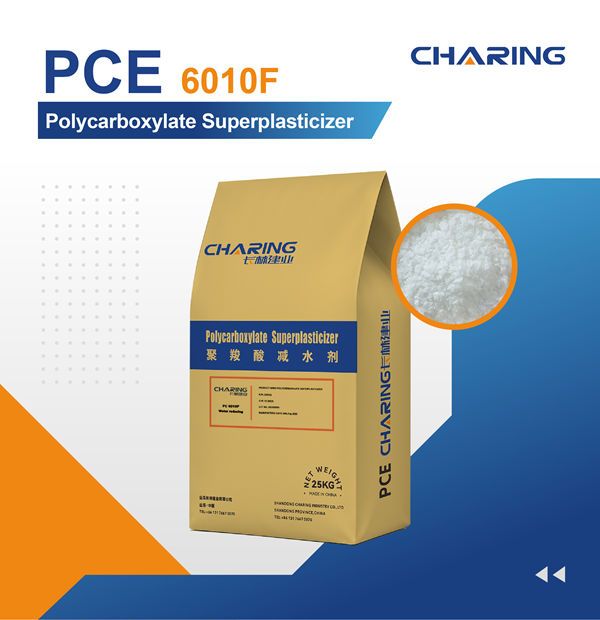
This is where a high-reduction PCE such as our PC 6010 does the job: it provides the water reduction and the flow that UHPC depends on, at the high dosage UHPC requires. Because the PCE dose is precisely linked to the final strength, a PCE with a stable, known active content matters even more here than in ordinary concrete.
UHPC is hard to mix, and you cannot do it in a normal mixer. The extremely low water content and high powder content demand a forced-action mixer (twin-shaft or planetary) — a gravity mixer will not distribute the fine powder or the fibres.
The mixing is done in three stages:
| Stage | What Happens |
| 1. Dry mixing | Cement, silica fume, quartz powder and sand, mixed 1–2 min |
| 2. Wet mixing | Add water and PCE, mix at least 5 min until flow develops |
| 3. Fibre addition | Add steel fibres slowly, then mix at least 2 min more |
Two casting rules also matter:
1.Do not rod or poke the concrete — UHPC must not be compacted by hand. Pour it from one side of the mould in one pass.
2.Remove air by tapping or light vibration — for low-flow mixes (below 650 mm), a short 10–15 s vibration may be used, otherwise tap the mould to release bubbles.
UHPC's full strength depends heavily on curing. It has two paths, and the standard steam-curing schedule is specific.
| Curing Method | Schedule | Typical Result |
| Steam curing | 90 °C ± 1 °C held for 48 h (heat ≤ 15 °C/h, cool ≤ 45 °C/h) | 150–180 MPa |
| Ambient moist curing | Standard moist curing, tested at 28 d | 130–150 MPa |
Two rules matter:
1.Steam curing gives the full strength. The heat accelerates the silica fume's pozzolanic reaction, which is what pushes the strength past 150 MPa. The temperature must be raised and lowered slowly.
2.Early moisture is critical. With such a low water-binder ratio and a high silica fume content, UHPC shrinks early — cover the surface with film immediately after casting and keep it wet.
The test age also differs: heat-cured UHPC is typically tested at 7 days, ambient-cured at 28 days.
UHPC is checked on mechanical performance, durability and shrinkage.
Mechanical and durability requirements:
| Property | Structural (ST) | Non-structural (NST) |
| Compressive strength | ≥ 120 MPa | ≥ 100 MPa |
| Flexural strength | ≥ 14 MPa | ≥ 10 MPa |
| Elastic modulus | ≥ 40 GPa | ≥ 40 GPa |
| Tensile grade | ≥ UT2 | ≥ UT1 |
| Chloride diffusion | ≤ 0.40 × 10⁻¹² m²/s | ≤ 0.60 × 10⁻¹² m²/s |
Fresh-concrete (workability) requirements:
| Property | Requirement |
| Spread (flow) | ≥ 650 mm |
| Spread loss over time | ≤ 100 mm |
| Spread time | 3–10 s |
Shrinkage requirements:
| Property | Ambient-cured | Heat-cured |
| Drying shrinkage | ≤ 300 × 10⁻⁶ | ≤ 100 × 10⁻⁶ |
| Early-age autogenous shrinkage | ≤ 1000 × 10⁻⁶ | — |
The compressive strength is the headline number, but the durability tests — especially chloride diffusion — are what justify UHPC's long service life in bridges and marine structures.
How much stronger is UHPC than normal concrete?
Roughly 4 to 6 times — UHPC is 120 MPa and above, against 30–60 MPa for ordinary concrete.
Why is the PCE dosage so high in UHPC?
Because the water-binder ratio is so low (0.14–0.22) and the powder content is so high. Only a strong dose of a high-range water reducer can make it flow — the standard requires a water reduction of at least 30%.
Can UHPC be mixed in a normal mixer?
No. It needs a forced-action (twin-shaft or planetary) mixer, and the fibres are added last at low speed.
Does UHPC need steam curing?
Steam curing at about 90 °C gives the full 150–180 MPa. Ambient moist curing works, but the strength is slightly lower.
What admixtures does UHPC need?
Mainly a high-reduction PCE (1.2–1.5%) and a powder defoamer. Some mixes add an expansion agent or retarder.
To see how UHPC's low water-binder ratio works, read Why Does Less Water Make Concrete Stronger? (The Water-Cement Ratio).
For the same principles at a lower strength grade, read How to Design High-Strength Concrete (C60 and Above).
To choose the right PCE for a high-strength application, read Which Polycarboxylate Superplasticizer (PCE) Should You Choose?.

E-mail: sdcharing@sdcharing.com
Phone: +86 131 7667 0070
WhatsApp: +8615066133527
Add.: No.605-606,NO1 BUILDING,WANGYUE ZHIGU INDUSTRY PARK,NO.1919 WANGYUE ROAD, SHIZHONG AREA,JINAN CITY, SHANDONG PROVINCE,CHINA